When Inspiration Nearly Went Flying Across the Room
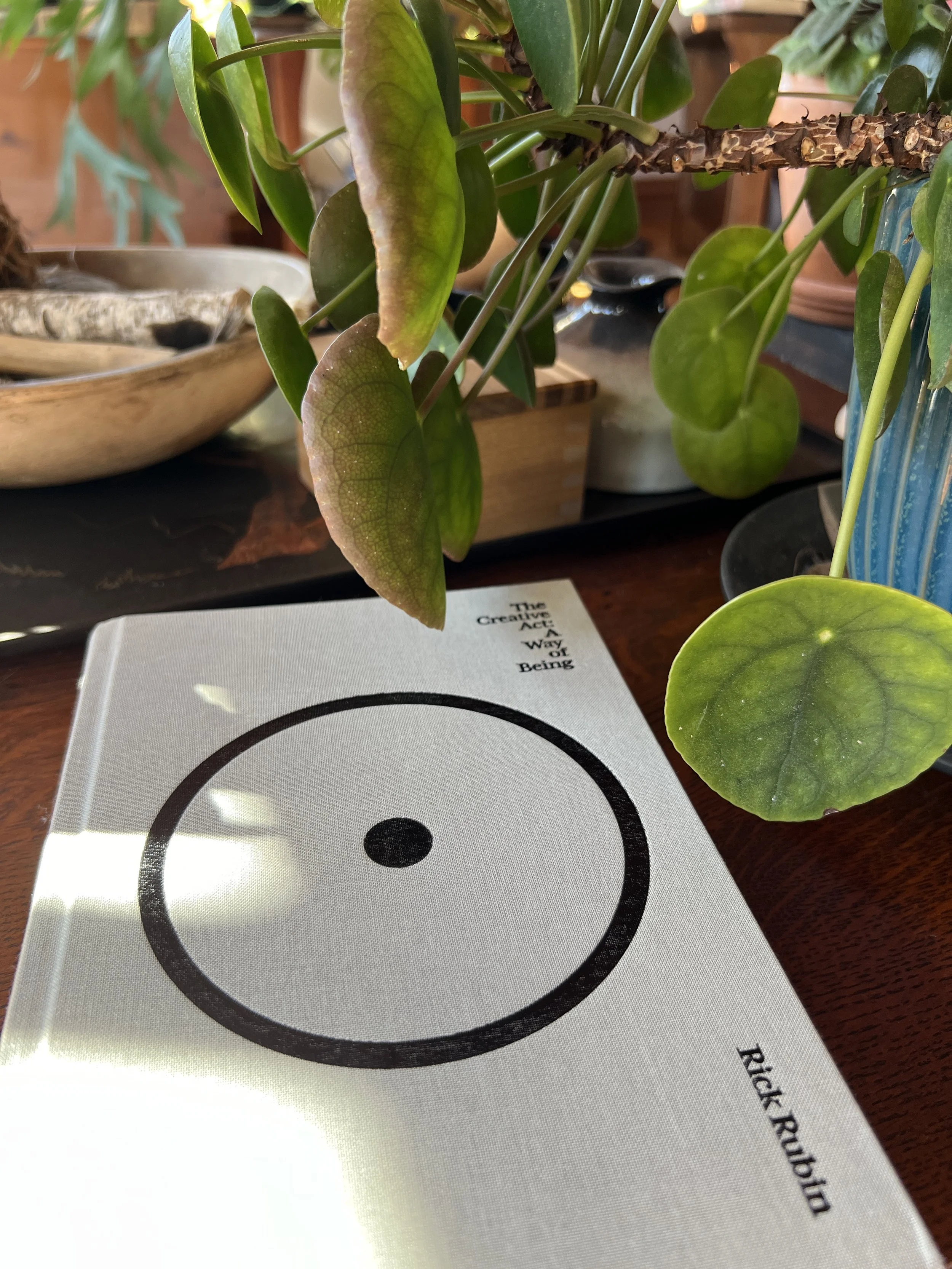
I almost threw this book across the room the first time I tried reading it. I didn't, because it was on my Kindle and because I'm not that kind of reader. Instead, I returned it to the library.
The Creative Act: A Way of Being by Rick Rubin
The book felt like a fantasy novel where Rubin writes about a world where art flourishes in optimal conditions. There is a list: "Thoughts and habits not conducive to the work" which includes "Prioritizing other activities and responsibilities over your commitment to making art" (139).
Um, who is going to tell my son that? My husband? My parents? My cats? Perhaps I was reading the book during a particularly stressful week when all my responsibilities meant I wasn't in the studio. I had this vision that to live the real artist's life, you either had to be completely by yourself or have staff taking care of all "life" stuff so that you could focus only on your art. I was not in the right head space to fight that list, so I gave up reading the book.
And then I tried again, listening this time, but I couldn't take it all in because this book is packed with ideas organized as "78 Areas of Thought" and I'd still be thinking through one area only to be moved on to the next one. This book is loved by many- I had to be missing something, so I bought a copy. I tried to read it straight through, as most books are intended to be read, but I kept getting overwhelmed by Rubin's thoughts and couldn't process them quickly enough. It was the audiobook problem all over again.
Then Rubin solved the problem for me in the Area of Thought "Look for Clues." He writes:
You might imagine that the outside world is a conveyor belt with a stream of small packages on it, always going by. The first step is to notice the conveyor belt is there. And then, any time you want, you can pick up one of those packages, unwrap it, and see what's inside.
A helpful exercise might be opening a book to a random page and reading the first line your eyes find. See how what's written there somehow applies to your situation. Any relevance it bears might be by chance, but you might allow for the possibility that chance is not all that's at play. pgs. 38-39
As artists, we go through the day noticing a perfect shadow, a carpet of dewy spiderwebs across the lawn, or the moment the sun breaks through the clouds and the colors change. This is what leads my son to constantly ask, "Mom, are you distracted again?"
I started reading Rubin's book using his suggested exercise. While drinking my coffee, I'd open it to a random section and start reading. Sometimes I'd instantly connect and other times I'd move on. Or, I'd look at the table of contents and choose one of the Areas of Thought, which are given titles like "The Gatekeeper" and "Clean Slate" and read to discover what he meant by that.
Such relief! This is how I approach art books—not looking at every page, but dipping in at random to examine one or two images. This is when I started to connect with more of Rubin's views on creativity. It also might explain why so much of the book is repetitive. If you only read a section at a time, you might need a review of an idea before he can make a new point.
What does speak to me? Here's a quote from the Area of Thought- "Rules"
It's a healthy practice to approach our work with as few accepted rules, starting points, and limitations as possible. Often the standards in our chosen medium are so ubiquitous we take them for granted. They are invisible and unquestioned. This makes it nearly impossible to think outside the standard paradigm. p 99
I'd just given an artist's talk at the gallery where I explained that my letterpress printing methods would get me banned from a "real" print shop. I always say this as if I'm doing something wrong by not using most other printers' traditional inks and printing standards. I read this bit from Rubin and thought, Yes! I'm thinking outside the standard paradigm, and that's a good thing.
And if this wasn't enough insight, back to Rubin:
Your path is unique, for only you to follow. There is no single route to great art.
This doesn't mean ignore the wisdom of others. Receive wisdom skillfully. Try it on for size and see how it fits. Incorporate what's useful. Let go of the rest. And no matter how credible the source, test and tune in to yourself to discover what works for you. pg 326
That's how I'll continue to approach this book- to pay attention to what resonates with my life and practice and let go of the rest. I don't think I'll throw the book across the room after all.