What’s it All About?
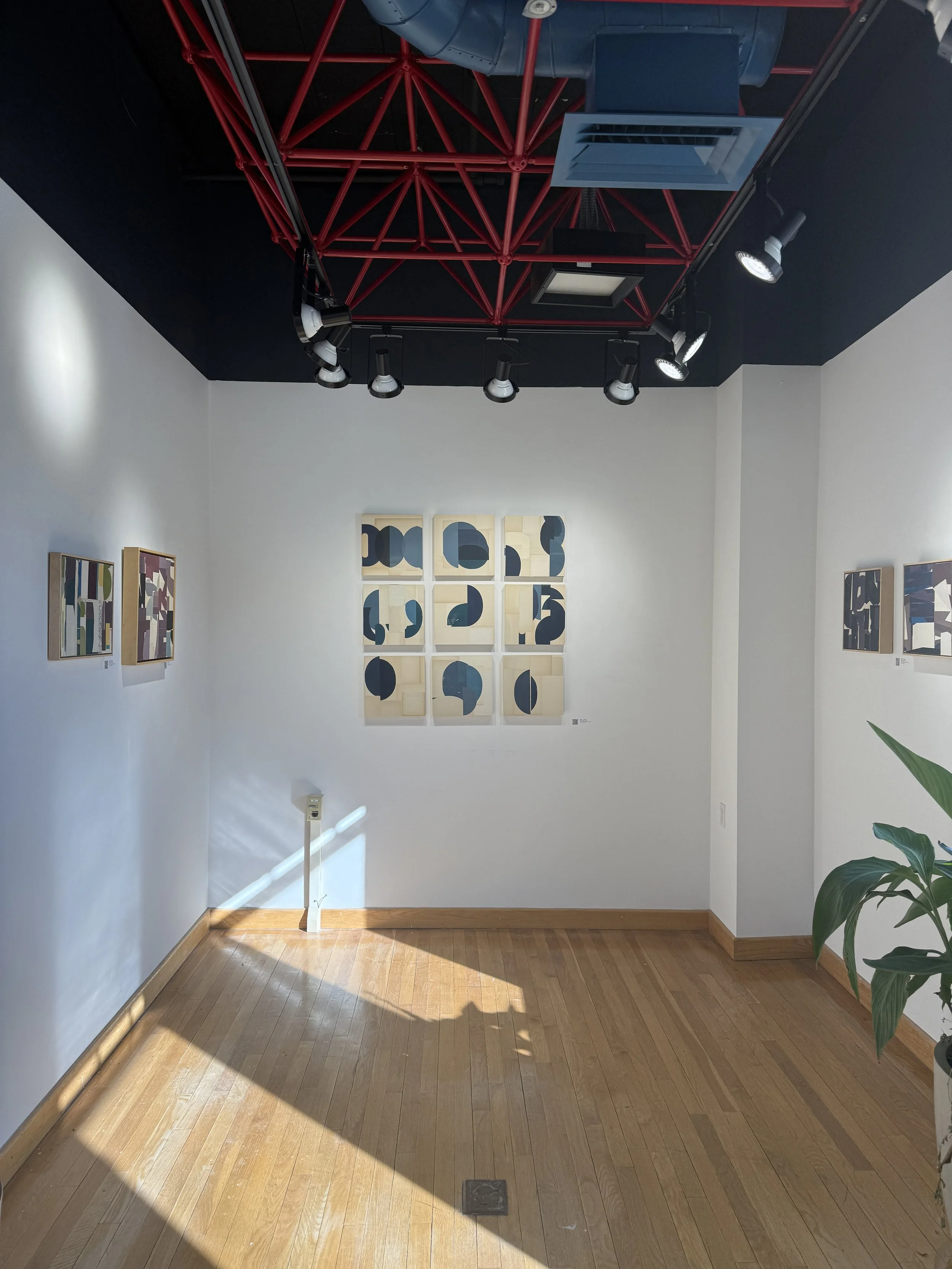
Sifted
I ran into an old friend, and she asked me how teaching was going. I responded that I’d left my job teaching middle school English and was now an artist. She shrugged and said, “Haven’t you always been an artist?”
Have I?
Maybe?
Artist Anne Truitt wrote in her journal about being asked by her daughter if artists were just born that way. Truitt responded that “they might be…she didn’t know, but that there was rarely a time when (she) wasn’t half-consciously translating what was around (her) into terms of art.”
I think that’s what I’ve been doing.
This show is about noticing where inspiration and ideas originate. It is about realizing how my experiences, art classes, education, and interests have all sifted together.
I never called myself an artist. I just liked to make stuff. And I tried making lots of different stuff—spinning, weaving, sewing, knitting, making paper, binding books, collage, and printmaking. I never painted, drew, or made pottery because that’s what actual artists did, and really, there is only so much time in a day.
What evolved was a practice based on paper that I could compose like a quilt or a tapestry but without all that pesky measuring. Collage can be small and portable and fit into motherhood.
My collages and interest in collage solidified when I took an online class with artist Melinda Tidwell, where deconstructed books provided the materials.
That resonated because I feel like all I’ve ever done is move books around as a reader and teacher.
Because books fall apart. They get moldy, eaten by mice, the spines break, the covers fall off, and the content is out of date or hurtful. The value of most books continues to decrease until they are discarded, not recycled, just thrown away. I get to do something more with them.
I don’t stop with books. I also use maps, stamps, receipts, letters, envelopes, sheet music, and other kinds of paper ephemera.
Each piece of paper is a story, and now they are part of something new.
The materials come from library book sales, estate sales, antique stores, online auctions, boxes left on the street, and Facebook Marketplace. I’ve been sourcing materials for long enough that I’ve made some friends who will reach out to me when they have books that they can’t resell, and I rescue them.
Letterpress Printing
Most of the papers I find don’t have any color other than the beautiful yellows and creams of faded papers.
If I want color, I add it through letterpress printing. For those unsure what that is, think movable type and the printing press.
I have two vintage proof presses, which allow me to make my prints using large wooden letters. I use acrylic paint instead of ink. My interest isn’t in the letter itself, but in the shapes I can create around it or by cutting it up.
I mix a color as a starting point, print, and keep mixing more colors into that first batch of paint, which creates a unified color scheme. I’ll print for several hours or until I’m out of space on my drying rack. Then I’m ready for collage.
The Collages
Anne Truitt wrote (I think you all know what I’m reading this week)
“The shape of my work’s development becomes a little clearer every time I am forced to articulate it”
And preparing this talk required me to figure out what I’ve been developing.
I approach a piece interested in making something new- by playing with whatever papers I’ve just created. I end up with a series of connected pieces because I’m using the same papers and colors and accidentally find myself exploring an idea that unifies the collection.
When I see them all together and write about them, I see what I’m up to.
Take this piece, “Blue Notes.” This piece was the beginning of my large-scale letterpress pieces, where I wasn’t including fabric book covers and other bits of ephemera. I was all in to seeing what happened when the prints drove the composition.
But there’s always a pull to combine those bold shapes with the poetry of other bits of pieces that tell such a strong story. That’s the visual language that’s easier for me to achieve in smaller pieces like “Pleasant Street” and “That Blue Box”. There are still pieces of my prints, but often, they are cut down so far that they read only as pieces of color and not as letterforms. I don’t find that as interesting as the type.
In “Stage Floor,” I tried to blend the abstraction of type and the stories in the paper by including theater blueprints and bringing in lots of open space that allows you to see the edges of the prints, and sometimes even an entire number. Like a theater production, there is order, space, and movement. I hadn’t made this connection until I started writing this talk.
What I see here is a move between the romance of the stories of vintage materials and the graphic nature of the abstracted prints with their strong shapes and colors. I’m constantly trying to balance the two ideas.
In the grid of nine, I returned to the shape and form of Blue Notes, but in a minimalist style. In each piece, there is a bold abstract letterform. Still, I was exploring the space outside the form and how the layers of paper could make the piece interesting and be as much a part of the composition as the bold shape you notice, especially when you stand back. How little could I add to a piece and still make it visually appealing? It ended up that one on its own was okay, but a little boring, but a grid of many that ranged from super simple to more complex told a much more interesting story. I’m always sifting through the same ideas and seeing what I can make of them.
It’s taken me a while to get comfortable with this artist label and settle into my artistic voice. However, I don’t think I need to be fully confident in either to keep creating.


